


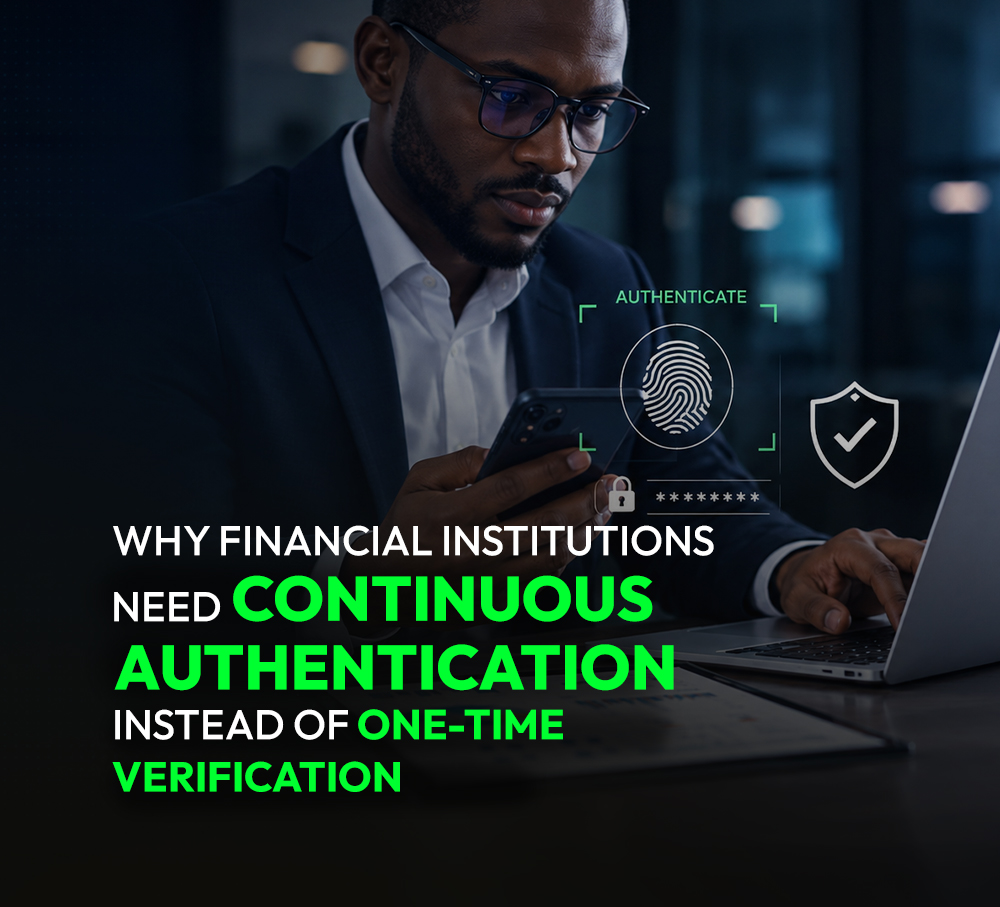
Continuous authentication verifies a customer’s identity throughout an entire banking session, not just at login. Financial institutions in Kenya are adopting this approach because one-time checks leave sessions unprotected once a user is authenticated. As fraud tactics move beyond the login screen, banks, fintechs, and insurers need identity checks that remain active for the duration of a session, without slowing down genuine customers.
This shift reflects a broader change in how digital trust is built, measured, and maintained across the entire customer relationship, not just at the point of entry.
The Changing Face of Digital Banking Risk
Fraud Has Outgrown the Login Screen
Banking fraud once targeted the login page, through guessed passwords, phishing, and weak PINs. Today’s threats operate after login succeeds. Session hijacking, malware that rides along with a legitimate user, and account takeover attacks account for a large share of losses across banking and payments. Deepfake technology has added a new layer of risk, producing synthetic faces and voices that can fool static, one-time checks. Fraud teams increasingly report incidents in which the initial login appeared completely legitimate, and the compromise only became apparent once unusual activity occurred within an already trusted session.
This shift has pushed security thinking towards Zero Trust security, a model built on the principle that no user, device, or session is trusted by default, regardless of how it was verified at the start. Trust is earned continuously, not granted once and assumed for the rest of a session. For institutions handling sensitive transactions daily, this is now a core requirement.
Why One-Time Verification Falls Short
The Trouble with a Single Verification Moment
One-time verification checks identity at a fixed point, usually login or account opening, then assumes that identity holds for the rest of the session. This leaves a huge gap. Once a session is authenticated, an attacker who has stolen a password or intercepted a one-time passcode can operate freely under someone else’s identity, often without triggering any alert until funds have already moved.
Traditional identity verification methods were built for branch-based banking and short digital sessions. Mobile banking, instant payments, and API-driven services have changed that. A customer’s identity now needs protection across multiple actions within a single session, not just the first. Static checks cannot detect a device change mid-session or a login from an unusual location minutes after a legitimate one, which is precisely where modern fraud tends to occur.
What Continuous Authentication Means for Financial Institutions
Verifying Identity Throughout the Entire Journey
Continuous authentication replaces the single checkpoint with ongoing, passive verification running in the background. It uses signals such as typing rhythm, touchscreen pressure, navigation patterns, device posture, and transaction timing to confirm that the person using an account is who they claim to be. These signals build a behavioural profile unique to each customer, which becomes more accurate the longer a system observes normal usage patterns.
When behaviour deviates from an established pattern, the system can trigger a step-up check—such as a biometric scan—only when risk rises. This keeps friction low for genuine customers while raising the barrier for attackers. Fraud can therefore be caught mid-session, during a transfer, or at a change of beneficiary, and not after the damage is done.
The Business Case for Continuous Authentication
Stronger Security Without Slowing the Customer Down
Security and convenience are often treated as opposing goals, but continuous models close that gap. Because verification runs passively, most customers never notice it. There is no repeated prompting for passwords or codes, which helps reduce drop-off during onboarding and transactions, and supports stronger long-term customer retention.
Account takeover and session hijacking remain leading causes of fraud losses in banking and payments, and both exploit the gap left by one-time checks. Strengthening identity verification throughout the session reduces this exposure without adding visible friction. It also supports fraud investigation, since continuous monitoring creates a behavioural record that helps institutions separate genuine disputes from fraud. Institutions built on Zero Trust security gain a stronger basis for detecting and containing incidents early, before losses escalate.
Regulatory and Industry Momentum Behind the Shift
Where Global Standards and Local Growth Meet
International frameworks—including NIST’s Zero Trust guidance—have pushed continuous, risk-based verification into mainstream banking security standards. Kenya’s regulatory environment is moving in the same direction. The rollout of Maisha Namba, the country’s lifecycle digital identity number, is reshaping how banks verify customers by linking birth records, biometric data, and government registries into a single verifiable reference point.
As digital identity infrastructure in Kenya matures, financial institutions gain a stronger foundation for real-time identity checks rather than one-off document reviews. Regulators, including the Central Bank of Kenya, continue tightening KYC expectations, making ongoing verification increasingly relevant to compliance and long-term regulatory readiness.
Attend WFIS Kenya and Help Build Kenya’s Next Generation of Financial Trust!
The World Financial Innovation Series (WFIS) in Kenya brings together banking, insurance and fintech leaders to discuss the practical challenges shaping digital finance, from fraud prevention and digital identity to the security of Kenya’s growing digital infrastructure. The event gives banks, regulators and technology providers an essential space to compare approaches and share what is working in the industry.
For institutions reviewing their authentication and security strategies, it is also an opportunity to hear how peers are responding to changing regulations, new fraud tactics and increasingly digital customer journeys. Scheduled to take place on 2 March 2027 at the Edge Convention Centre in Nairobi, WFIS Kenya provides a practical forum for understanding where the industry is heading, and how institutions are preparing for it.
Register today!
Frequently Asked Questions
How does continuous authentication differ from one-time verification?
One-time checks confirm identity at login, while continuous checks verify it throughout the session for stronger protection.
Does continuous authentication slow down the customer experience?
Verification runs quietly in the background, so genuine customers rarely notice extra steps, keeping the banking experience fast and simple.
How does a Zero Trust approach relate to ongoing checks?
Zero Trust assumes no session is automatically trustworthy, making ongoing identity checks essential rather than optional for financial institutions today.
What role does Maisha Namba play for Kenyan banks?
Maisha Namba links biometric and government records into a single verifiable identifier, helping Kenyan banks accurately verify customers and prevent duplication.
Why should Kenyan financial institutions invest now?
Evolving fraud tactics make ongoing verification key to reducing losses, meeting compliance needs, and protecting customer trust.