


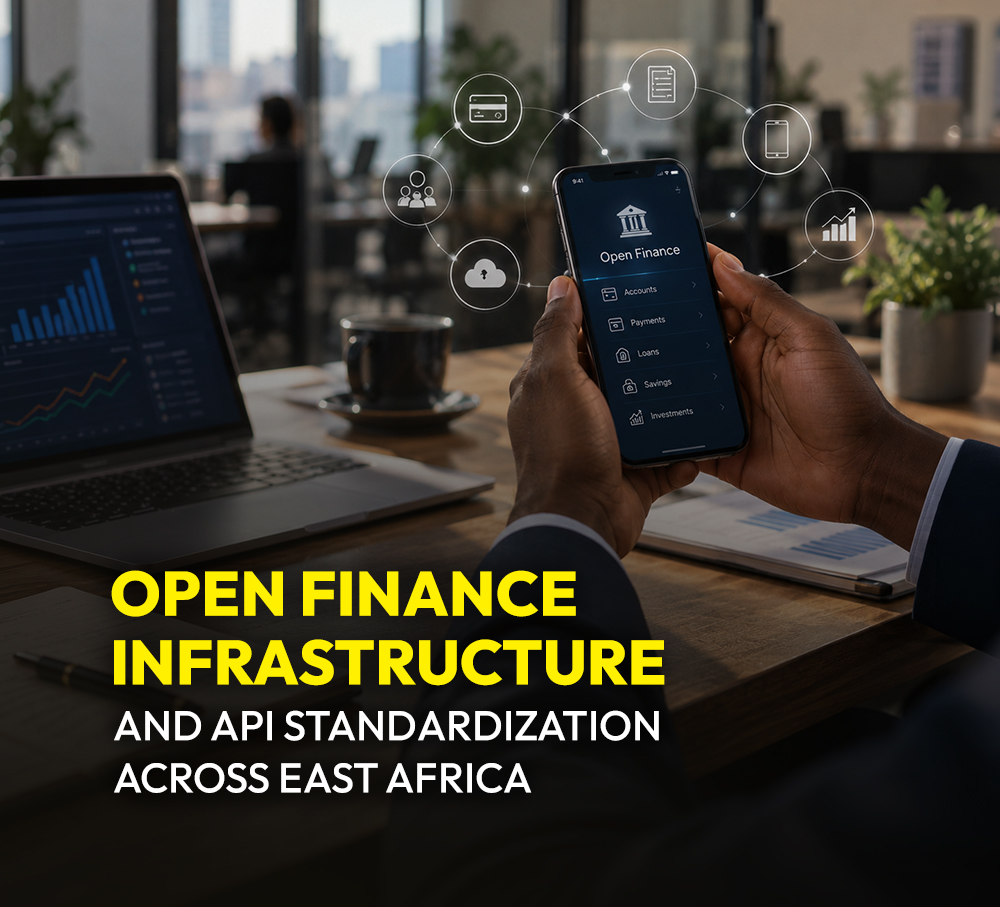
Open finance has transitioned from pilot to regulatory policy in East Africa. The Central Bank of Kenya’s National Payments System Vision and Strategy 2021-2025 mandates API standards and secure data portability, with full compliance expected by December 2026. For regional financial stakeholders, API standardization and data governance are now critical strategic priorities. Key industry dialogues on these developments are occurring at major forums like the banking technology conference circuit, including WFIS Kenya.
Why Open Finance Is Expanding Across East Africa
Growth of digital banking ecosystems
East Africa leads the continent with a projected GDP growth rate of 5.9% for 2025-2026, and the cross-border payments market is estimated at $329 billion in 2025, with projections of reaching $1 trillion by 2035. That commercial scale demands infrastructure to match.
Demand for connected financial services
Consumers and businesses across Kenya, Uganda, Tanzania, and Rwanda transact across borders regularly. Disconnected banking systems create friction at every step, from remittances to trade finance.
Expansion of mobile-first banking platforms
Kenya’s adult financial inclusion rate stands at 84.8%, built on interoperable digital payments and a dense fintech ecosystem centered around M-Pesa APIs and bank-fintech partnerships.
Role of APIs in financial interoperability
Kenya’s CBK draft open banking framework emphasizes REST APIs, secure authentication via OAuth 2.0, and ISO 20022 message standards, aligning with global technical norms while adapting them to Kenya’s context. Open Banking Nigeria
Financial inclusion through open finance access
Open finance regulations emerging in Kenya are driving competition from tech-enabled providers that leverage consented data flows for embedded credit, insurance, and savings.
The Importance of API Standardization in Banking Ecosystems
Secure and consistent API communication standards
API standardization and interoperable platforms allow ecosystem players to scale embedded finance models without duplicating infrastructure. Without this, every bank-to-fintech integration remains a bespoke, costly exercise.
Simplifying integration between banks and fintech firms
A fintech connecting M-Pesa in Kenya and MTN MoMo in another market must write two separate codebases and navigate entirely distinct compliance flows. Regional harmonization eliminates that overhead directly.
Improving customer experience across financial platforms
Standardized APIs reduce transaction errors, improve uptime, and deliver consistent experiences across mobile wallets, bank portals, and third-party applications.
Reducing operational complexity and integration risks
Inconsistent API protocols expand security vulnerabilities and multiply maintenance costs. Every non-standard integration is a risk point that standardization removes.
Supporting scalability across regional banking systems
Juniper Research projects global open banking API calls will grow from 137 billion in 2025 to 720 billion by 2029, driven by AI-powered personalization and expanding financial use cases. Regional systems need standardized architecture to absorb that growth.
Regulatory, Security, and Data Governance Considerations
Data privacy and customer consent requirements
Consent sits at the center of any credible open finance framework. Kenya’s regulatory approach requires customers to retain active, revocable control over their financial data before any third-party access is granted.
API security and authentication controls
Standardized API gateways should implement OpenAPI 3.0-compliant architecture with JWT-based authentication, OAuth 2.0, and rate limiting to prevent abuse, ensuring interoperability across all participants.
Third-party fintech risk management
Kenya’s Central Bank calls for clear risk management frameworks for every open API participant. Banks must assess vendors, monitor access continuously, and define security obligations for every third party.
Cross-border compliance challenges
The fundamental tension in African open finance lies between local innovation and cross-border scale, and resolving it demands standardisation. Divergent national requirements raise compliance costs for regional providers. Paylume
Governance frameworks for open banking ecosystems
The Open Finance African Group’s work includes establishing harmonised data processing standards and defining comprehensive business models for open banking and API frameworks across the continent. National frameworks need to connect to this regional effort to avoid fragmentation.
Business Opportunities Created by Open Finance Infrastructure
Embedded finance and Banking-as-a-Service opportunities
Banks that expose well-governed APIs to third parties can distribute financial products through non-banking platforms at minimal incremental cost, expanding reach without branch investment.
Cross-border financial collaboration
The evolution of real-time payment rails such as the Pan-African Payment and Settlement System may enable smoother integration of embedded financial flows across borders.
Personalised banking experiences through shared data
Consented data sharing enables accurate credit profiles, fairer insurance pricing, and services delivered at the point of need rather than the point of application.
New revenue channels through API-enabled services
A well-documented API product attracts developer ecosystems. Developer adoption becomes a revenue metric with direct commercial implications, not just a technical milestone.
Faster deployment of financial products
Standardised infrastructure reduces time-to-market for new lending, savings, and insurance products, giving institutions a measurable competitive advantage.
Strategic Priorities for Banks, Fintech Firms, and Technology Providers
Investment in scalable API infrastructure
Infrastructure decisions made now determine how quickly institutions respond to regulatory mandates and competitive pressure over the next decade.
Building secure open finance ecosystems
Kenya’s CBK API standards cover specifications for identification, verification, authentication, customer account data access, transaction initiation, and coding formats. Security must be embedded from the architecture stage, not added later.
Collaboration between banks and fintech companies
Institutions should participate in national working groups and standardization bodies to shape frameworks rather than reactively follow them.
Long-term digital banking transformation planning
Short-term API deployments without a multi-year roadmap accumulate technical debt. Regional harmonization requires planning beyond the immediate compliance window.
Supporting customer trust through secure data-sharing systems
Transparent consent mechanisms and accessible privacy controls are prerequisites for customer adoption, not optional enhancements.
Explore Open Finance Innovation at WFIS Kenya
The 8th edition of the World Financial Innovation Series (WFIS) is scheduled for 2 March 2027 at the Edge Convention Centre, Nairobi. The event brings together 500+ pre-qualified delegates, 100+ leading organizations, 40+ industry visionaries, and 25+ solution providers spanning banks, insurers, microfinance institutions, and fintech organizations. For institutions navigating API standardization, embedded finance strategy, and regional compliance in East Africa, the open banking exhibitions such as WFIS Kenya provides direct access to regulators and technology leaders shaping these frameworks. This is a targeted platform for organizations building the infrastructure East Africa’s financial future depends on.
Frequently Asked Questions
1. What does open finance infrastructure mean for East African banks?
It refers to standardized, API-driven systems enabling secure data exchange across institutions, borders, and financial service providers.
2. Why is API standardization critical for fintech Kenya growth?
Without consistent standards, every bank-fintech integration requires separate development, raising costs and slowing product deployment considerably.
3. When will Kenya’s open banking framework be fully implemented?
Full compliance with CBK’s draft open banking framework is currently targeted for December 2026, following a phased rollout.
4. How does an API banking showcase event like WFIS Kenya support industry alignment?
It brings regulators, banks, and solution providers together to align on standards, share implementation experience, and establish regional partnerships.
5. What business opportunities does open finance create for East African institutions?
Embedded finance, Banking-as-a-Service distribution, consent-based credit scoring, and API-enabled product deployment all become viable at scale with standardized infrastructure.