


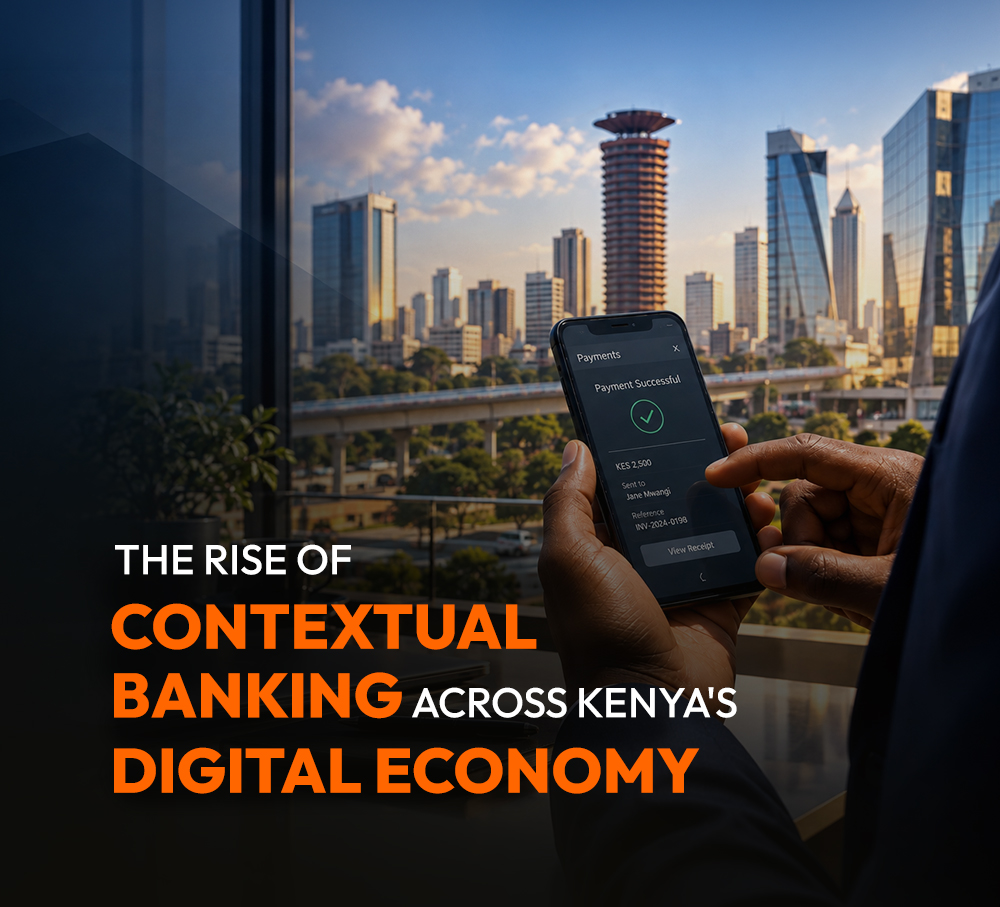
Contextual banking refers to the financial service delivery built around a customer’s real-time situation rather than a generic product catalogue. It places the right financial offer at the right time within the app or platform a customer is already using, whether that is a ride-hailing service, an agritech marketplace, or a retail checkout page.
Already active across Kenya’s mobile wallets, bank APIs, and merchant platforms— which together reach tens of millions of people daily—this approach is transforming financial services into seamless experiences. Understanding why this model is spreading and how quickly it is spreading across banking, insurance, and lending matters for every bank, fintech, and platform operating in the country today.
Kenya’s Digital Economy as Fertile Ground for Contextual Banking
A Population Ready for Smarter Financial Services
Kenya has spent over a decade building the infrastructure that enables contextual services. Mobile money penetration reached 91% by mid-2025, according to the Communications Authority of Kenya. Mobile connections now exceed the total population, and broadband coverage is set to reach nearly 95% of those connections by 2030. Most Kenyans already carry a working financial identity in their pocket, built through years of daily mobile money use.
That foundation has turned digital banking in Kenya into far more than a convenience layer atop traditional branches. It is now the primary channel through which people save, borrow, and pay, replacing branch visits for most everyday financial activity. Moreover, Kenya’s ICT sector is projected to contribute over 9% to GDP. Banks therefore now compete on relevance and timing, not just access to customers.
Understanding Contextual Banking
Beyond Digital Banking Toward Situational Banking
Contextual banking responds to a specific situation rather than waiting for a customer to log in and search for a product on their own.
- A farmer buying seeds through an agritech app might be offered a short-term input loan at the point of purchase.
- A small trader accepting mobile payments might be offered a working capital advance based on daily sales patterns.
- A ride-hailing driver might be offered a vehicle insurance price based on actual trip data rather than a flat annual premium.
This is where embedded finance initiatives in Kenya add value, allowing banks and licensed providers to plug financial products directly into non-financial platforms via APIs. The financial service travels to where the customer already is, guided by real transaction data rather than static profiles built on assumptions.
Key Drivers Fueling the Shift Towards Contextual Banking
Technology and Expectation Moving Together
Several forces are pushing this shift at once, reshaping how institutions design and distribute their products:
- Open banking frameworks and stronger API infrastructure let institutions share data securely with fintech partners, sharpening credit scoring for customers with thin financial files.
- Real-time payment rails and interoperable mobile money systems settle transactions instantly, giving lenders and insurers fresher data to act on immediately.
- Customers accustomed to instant mobile money transfers now expect the same speed from credit, savings, and insurance products.
- Non-bank platforms, including e-commerce sites, gig apps, and government digital services, are building financial features users increasingly expect.
These pressures help explain why fintech in Kenya has evolved rapidly from basic payment solutions towards more sophisticated infrastructure designed for embedding within other platforms and services, rather than operating solely as standalone products.
Benefits for Institutions and Customers
A Value Exchange Built on Relevance
Contextual banking rests on a clear exchange of value between institutions and the people they serve. Customers receive financial products matched to their real circumstances rather than generic, broad-based offers. For example:
- A trader gets a loan sized to actual cash flow, not a fixed generic amount
- A farmer gets insurance priced against real crop risk, not a flat regional rate
Institutions gain access to distribution channels they could not build on their own, reaching customers through platforms that already hold their daily attention and trust. This lowers acquisition costs and improves repayment behaviour, since credit offered at the point of need tends to be used as intended. Partner platforms gain new revenue and stronger retention. Growing contextual banking partnerships built on embedded models are also extending measurable financial inclusion to underserved communities across the country.
Challenges and Considerations
Balancing Innovation With Responsibility
None of this progress removes the underlying risks that come with speed and convenience:
- Embedding credit into everyday apps raises questions about responsible lending, especially when offers appear at moments of urgency rather than careful thought.
- Data sharing between platforms and institutions must meet strict privacy standards, as digital banking in Kenya increasingly draws on transaction histories from multiple sources.
- Regulatory clarity is still developing. The Central Bank of Kenya and the Communications Authority continue to refine rules on data protection, non-bank licensing, and consumer protection for embedded products.
- Instant credit at checkout can also encourage borrowing beyond what a customer can comfortably and realistically repay.
Getting this right requires applying the same level of regulatory and institutional scrutiny to embedded financial products as is already applied to conventional lending, ensuring that innovation does not come at the expense of consumer protection, transparency, and responsible risk management.
Register for WFIS Kenya and Lead Kenya’s Contextual Banking Future!
Kenya’s banks, insurers, and fintech firms are actively redesigning products and partnerships in response to this shift, and these are exactly the conversations shaping the core agenda of the World Financial Innovation Series (WFIS) in Kenya.
The event, scheduled to take place on 2 March 2027 at the Edge Convention Centre, Nairobi, is set to convene senior decision-makers from banking, insurance, and microfinance to examine embedded lending models, open banking governance, and what responsible contextual products look like in practice today.
For institutions and technology providers working in embedded finance in Kenya, WFIS remains the region’s most prominent platform for these discussions and collaborations. For more information regarding the upcoming edition, visit https://kenya.worldfis.com/
Frequently Asked Questions
What is contextual banking?
Contextual banking delivers relevant financial products, such as credit or insurance, at the exact moment a customer actually needs them.
How does contextual banking differ from digital banking?
Digital banking moves existing banking services online, while contextual banking responds to real situations using embedded, real-time behavioural triggers instead.
Which sectors in Kenya use embedded finance most?
Ride-hailing, agritech, e-commerce, and gig economy platforms across Kenya now widely embed payments, credit, and insurance features directly for users.
Is contextual banking regulated in Kenya?
Yes, contextual banking in Kenya is regulated through a combination of existing financial, telecommunications, and data protection frameworks.
Why does this model matter for financial inclusion?
It extends credit, savings, and insurance to underserved Kenyans, using real transaction data rather than traditional collateral or credit history.