


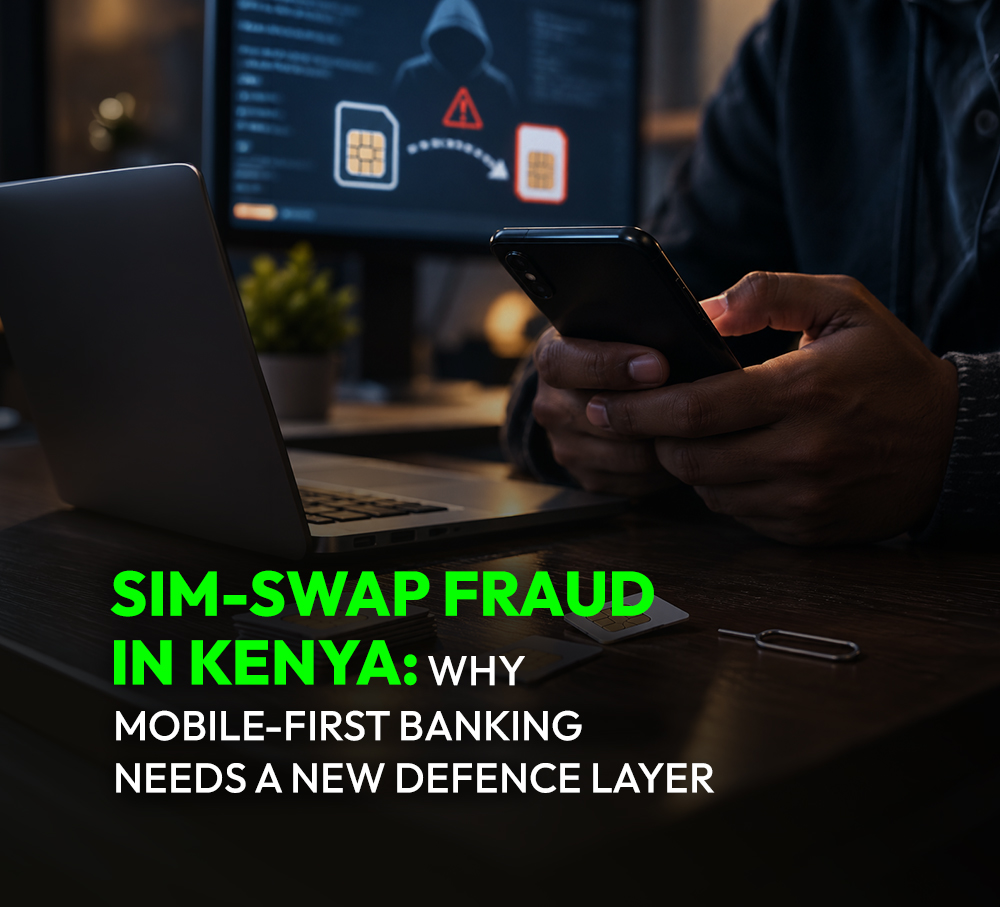
Kenya built one of the world’s most admired mobile money economies, turning ordinary phone numbers into financial identities. That success now carries a growing risk. SIM-swap fraud lets criminals hijack a phone number and, with it, access bank accounts, mobile wallets, and personal savings. As digital banking platforms in Kenya expand into daily life, from salaries to school fees, the very convenience that enables them has become a single point of failure. Understanding how this fraud works and why current defences fall short matters for banks, telecom operators, and everyday users seeking to protect their money.
Understanding SIM-Swap Fraud
How Fraudsters Hijack a Mobile Number
SIM-swap fraud occurs when a criminal convinces a mobile network to transfer a victim’s phone number to a SIM card they control. This is usually achieved through social engineering, forged identification, or bribed insiders at telecom outlets. Once the transfer completes, the fraudster begins receiving the victim’s calls and messages, including one-time passwords used to authorise bank transfers and mobile money withdrawals. The original phone typically loses signal without warning, often the first sign something is wrong. By the time a victim notices the outage and contacts their bank, funds may already be gone, since the entire process can take minutes.
The Scale of the Problem in Kenya
Numbers That Show the Real Exposure
Kenya’s exposure is tied directly to how central mobile phones have become to financial life. Mobile subscriptions stood at over 71.4 million as of December 2024, and mobile money subscriptions recently exceeded 40 million users. Safaricom alone processes nearly 28,000 SIM-swap requests daily, a volume that gives fraudsters constant opportunities to slip through. Between July and September 2025, Kenya’s National KE-CIRT/CC recorded 842 million cyber threat events, with an estimated KES 29.9 billion in cybercrime-related losses that quarter. Mobile banking fraud cases surged 87% year on year, much of it linked to SIM-swap schemes. Every credible banking solution provider in Kenya today must be measured against this scale.
Why Mobile Money Makes Kenya a Bigger Target
A Financial System Built Around the Phone Number
Kenya’s financial inclusion story rests on a simple design choice: the phone number doubles as the account identifier. This made banking accessible without branches or paperwork, but it also concentrated risk in a single credential. A stolen number does not just expose a call log or a chat app. It can unlock mobile wallets, savings products, loans, and linked bank accounts in a single stroke. Fraudsters understand this concentration and deliberately target it, knowing that a single successful swap can grant access to multiple financial services at once, particularly where point-of-SIM-replacement verification remains inconsistent.
Current Safeguards and Their Limits
What Telecoms and Regulators Have Already Done
Kenyan telecom operators and regulators have not ignored the problem. Safaricom has introduced USIM protection services that let customers block their number from being ported to another SIM card, and the Office of the Data Protection Commissioner has issued determinations tightening the rules on how personal data is collected and processed across telecom services. These steps have measurably reduced incidents per volume, with around 40 fraud cases per 750,000 SIM swaps processed. Yet protection still depends heavily on manual verification and customer opt-in. As digital transformation in Kenya initiatives push more services online, safeguards built for a smaller financial system are being stretched by scale and speed.
The Case for a New Defence Layer
Moving Beyond SMS-Based Trust
SMS-based one-time passwords were designed for a simpler threat environment and are no longer sufficient on their own. A meaningful defence layer needs device-level signals, behavioural pattern recognition, and real-time risk scoring rather than a single text message. This is where AI in Kenyan banking applications show genuine promise, flagging unusual login locations, sudden device changes, or atypical transaction patterns before money moves. Pairing this with biometric verification and cross-checks between telecom and banking systems would close many gaps criminals currently exploit. For digital banking platforms in Kenya to stay trustworthy, fraud detection must shift from reacting after a swap to predicting risk before it occurs.
What Individuals and Businesses Can Do Now
Practical Steps for Everyday Protection
While systemic fixes take time, individuals and businesses can reduce exposure today:
- Enable SIM-swap protection or number-porting locks offered by mobile operators.
- Avoid relying solely on SMS for two-factor authentication when an authenticator app is available.
- Set strong, unique PINs and passwords on mobile money and banking apps.
- Monitor phone signal and transaction alerts closely and act immediately if service drops unexpectedly.
- Limit personal information shared publicly that could answer security questions.
Businesses relying on any banking solution in Kenya for payroll should separate approval and payment roles so that no single compromised device can authorise a transfer.
Explore Mobile-First Banking and Security at WFIS Kenya
Mobile-first banking has transformed how Kenyans save, borrow, and transact, but its convenience must now be matched by stronger security. Closing the SIM-swap gap requires cooperation among telecom operators, banks, regulators, and informed users who take basic precautions seriously. Progress on digital transformation in Kenya cannot be measured solely by adoption numbers; it must also account for how safely that adoption occurs. World Financial Innovation Series (WFIS) Kenya tracks these developments closely, examining how AI in Kenyan banking, stronger identity verification, and coordinated regulation can rebuild trust in mobile-first finance. Readers working in banking, telecoms or policy are encouraged to follow this coverage as the sector responds.
Frequently Asked Questions
What is SIM-swap fraud?
SIM-swap fraud occurs when criminals transfer a victim’s phone number to a SIM card they secretly control, gaining full access.
Why is Kenya especially vulnerable?
Kenya’s financial system treats phone numbers as account identifiers, so a stolen number can quickly expose several linked financial accounts.
Can SIM-swap fraud be prevented completely?
No single safeguard completely prevents SIM-swap fraud, but layered verification, monitoring, and biometric checks significantly reduce the number of successful attempts nationwide today.
What should victims do immediately?
Contact your telecom provider and bank immediately to freeze the compromised number and lock all linked accounts from further transactions.
Are telecom operators doing enough?
Operators have introduced porting locks and stronger verification steps, though gaps still remain in consistency and enforcement across providers nationwide.