


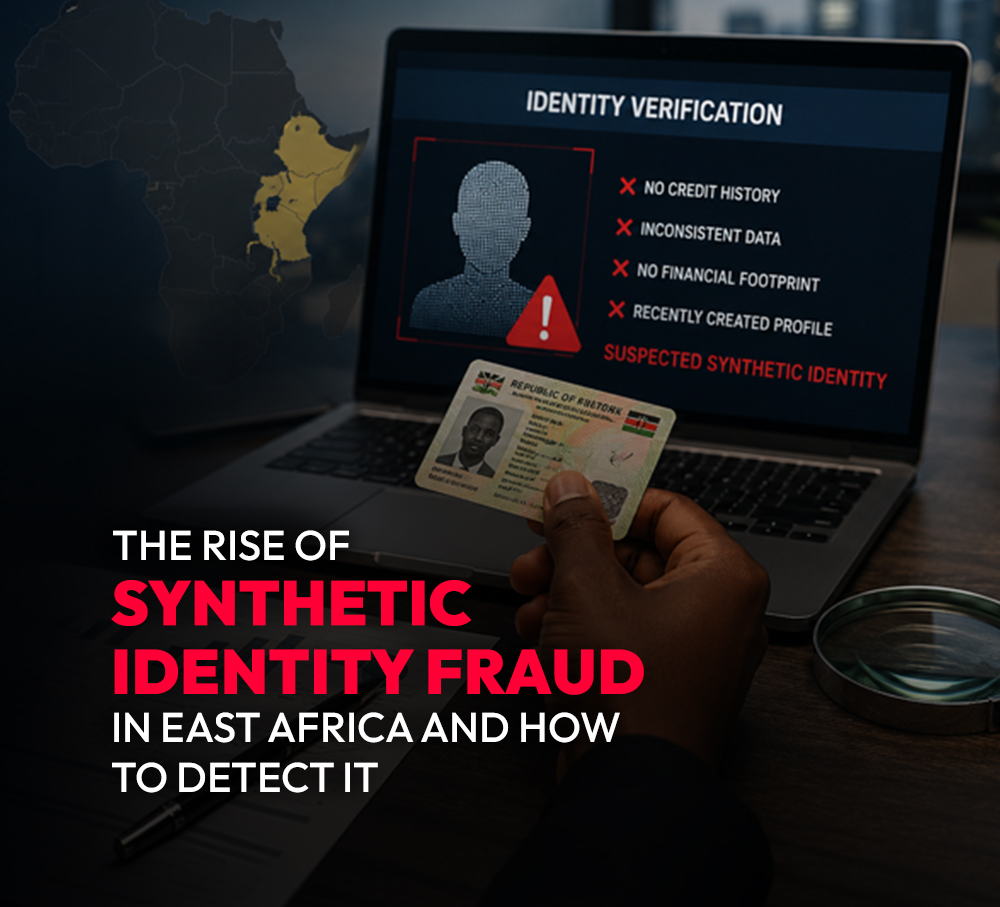
East Africa’s financial sector is expanding faster than its verification systems. The rapid adoption of mobile money and digital banking platforms in Kenya has introduced synthetic identity fraud, a threat that constructs non-existent personas by blending genuine and fabricated details.
Unlike traditional identity theft, this method lacks a single victim to flag suspicious activity, making it harder to detect. For regional banks, fintechs, and regulators, mastering the construction and detection of these identities is now essential.
What is Synthetic Identity Fraud
How Synthetic Identities Are Built
Synthetic identity fraud combines genuine personal information, such as a national ID number or phone number, with fabricated details like a false name, birth date, or employment record. Fraudsters often obtain partial data from leaked databases, phishing, or social engineering, then merge it with fabricated elements to create a profile that appears authentic on paper. Once this fabricated identity clears initial checks, it can be used to open bank accounts, apply for loans, or register mobile money wallets. Some fraudsters nurture these profiles for months, building a modest transaction history before attempting larger fraudulent withdrawals.
Why It Differs From Traditional Identity Theft
Traditional identity theft impersonates a real, living person, so the victim can eventually notice unauthorized activity and report it. Synthetic identities have no single victim to watch over them, allowing suspicious activity to go unnoticed for months. This missing whistleblower is exactly what makes synthetic fraud harder to trace, harder to reverse, and far more costly once discovered.
Why Synthetic Identity Fraud Is Rising Across East Africa
Rapid Growth of Mobile Money and Digital Lending
Financial digitization across Kenya, Uganda, and Tanzania has outpaced the verification infrastructure needed to catch fabricated profiles. As lending apps compete to onboard customers instantly, fewer manual checks occur, giving fraudsters room to push synthetic profiles through automated systems. The pace of digital transformation in Kenya—particularly in mobile money and digital lending—continues to widen the gap between innovation and oversight.
Regional Vulnerabilities
East Africa still depends heavily on physical identity documents rather than centralized digital verification databases, and this gap is precisely what fraudsters exploit through forged or altered paperwork. Many verification systems also struggle to communicate across borders, allowing the same fabricated profile to resurface under a slightly different institution.
Data From the Region
Smile ID’s 2025 report on ‘Digital Identity Fraud in Africa’ found that East Africa recorded a 27% rejection rate for biometric and document verification, the highest of any African region, driven largely by reliance on outdated identification documents.
Kenya alone lost an estimated $83 million to cybercrime in 2023, according to the Communications Authority of Kenya, a figure that continues climbing as fraud tactics grow more sophisticated.
Common Techniques Fraudsters Use to Create Synthetic Identities
Document and Data Manipulation
Fraudsters rely on several recurring methods to build synthetic profiles that pass initial scrutiny, and without a reliable banking solution, Kenyan lenders remain exposed at these weak checkpoints.
- Altering scanned identity documents or photographs to appear genuine
- Submitting non-genuine or screen-captured documents that pass surface-level review
- Recycling fragments of real identity data across several separate applications
Artificial Intelligence and Deepfake Tools
The same AI helping Kenyan banks speed up customer onboarding is also creating new risks. Deepfakes and AI-generated faces are being used to try to bypass facial recognition and liveness checks, a trend highlighted in recent biometric fraud reports from across the region.
Exploiting System Gaps
Weak cross-referencing among telecom, banking, and national registry databases allow fraudsters to reuse fragments of real data across multiple fake applications without raising alarms.
How Businesses Can Detect Synthetic Identity Fraud
Behavioural and Pattern-Based Detection
Institutions are shifting from one-time onboarding checks towards continuous behavioural monitoring. Unusual login locations, inconsistent device usage, or transaction patterns that do not match a customer’s stated profile are strong warning signs.
Technology-Driven Verification
A dependable banking solution that Kenyan institutions can rely on should combine biometric liveness checks, document authentication, and database cross-referencing, rather than relying on a single verification layer. Reverifying returning users regularly adds a further defense against identities that pass onboarding but behave suspiciously afterwards.
Human and Institutional Oversight
Automated systems perform best when paired with trained fraud analysts who manually review flagged cases. Institutions that combine technology with experienced human judgment consistently detect synthetic profiles that algorithms alone tend to miss.
Regulatory and Industry Response Across the Region
Strengthening Verification Standards
Regulators across Kenya, Uganda, and Tanzania are pushing institutions towards stronger KYC protocols and centralized identity verification systems to close existing gaps.
Regional Collaboration
Cross-border cooperation, including INTERPOL-backed operations against cybercrime networks spanning multiple African nations, reflects growing recognition that fraud rings operate beyond national borders and demand coordinated regional responses.
Where WFIS Kenya Fits Into the Fight Against Identity Fraud
The rise of synthetic identity fraud thus highlights a growing need for stronger verification and collaboration across Kenya’s financial ecosystem. As fraudsters adopt more sophisticated methods, institutions must look beyond one-time KYC checks and build layered defenses that combine technology, behavioural analysis, and human oversight.
The World Financial Innovation Series (WFIS) in Kenya provides a timely, essential platform for financial institutions, regulators, technology providers, and cybersecurity experts to come together and examine these challenges. Scheduled to take place on 2 March 2027 at the Edge Convention Centre, Nairobi, the summit facilitates turning shared insights into practical strategies through expert-led panel sessions, keynote presentations, and cross-industry collaboration.
Registrations are open. Don’t miss out.
Frequently Asked Questions
What makes synthetic identity fraud hard to detect?
It blends real and fabricated data, so no single victim exists to notice or report suspicious activity early on.
How does synthetic fraud affect banks in Kenya?
It results in financial losses, erodes customer trust, and forces institutions to invest heavily in stronger verification systems and monitoring.
Can artificial intelligence help stop synthetic fraud?
Yes, AI-driven behavioural monitoring and biometric verification helps identify inconsistencies that manual checks often miss.
Why is East Africa particularly vulnerable to this fraud?
Heavy reliance on physical documents and weak database cross-referencing create verification gaps that fraudsters regularly exploit across the region.
What role does WFIS Kenya play in fraud prevention?
It brings industry leaders together to discuss verification technology, regulatory standards, and coordinated strategies to prevent regional identity fraud.