


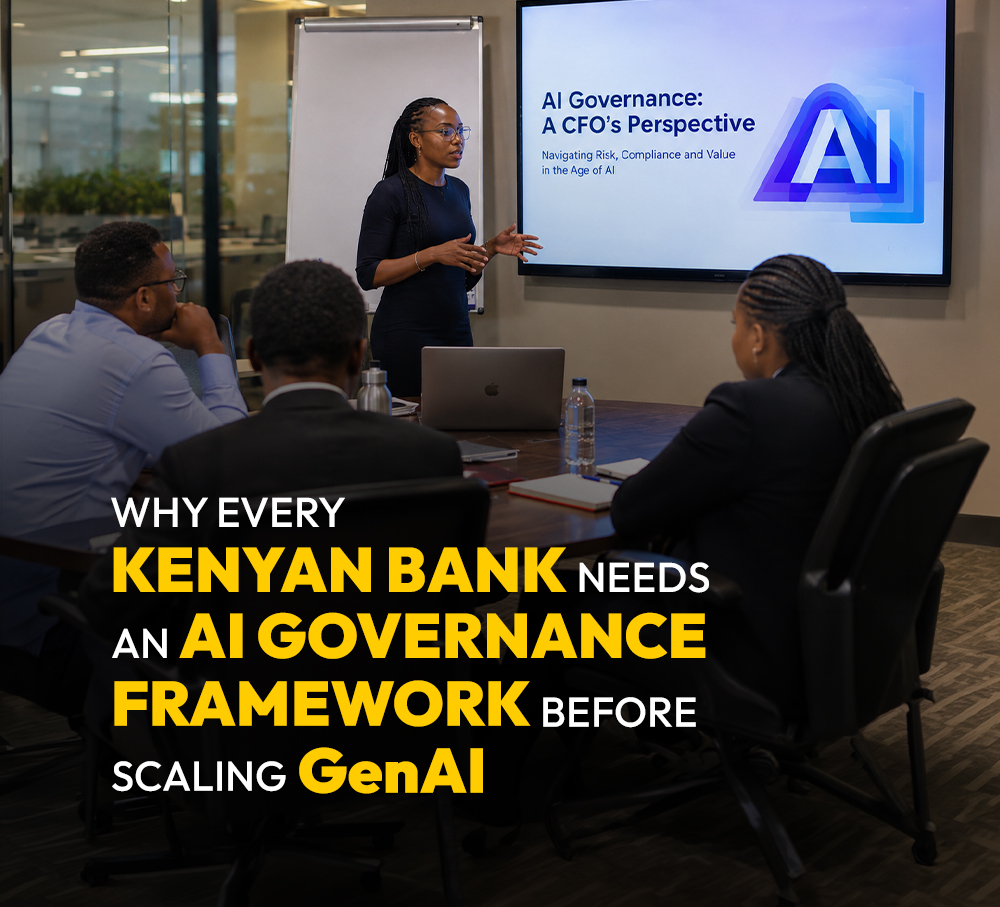
An AI governance framework is the structural safeguard Kenyan banks need before scaling generative AI in customer service, credit, and fraud detection. Kenyan banks have moved past pilot testing: chatbots answer customer queries, credit models score borrowers within seconds, and back-office teams use AI to speed up compliance work. Data provided by the Central Bank of Kenya shows most lenders are still in early stages of AI maturity, even as adoption expands quickly.
Without formal governance, scaling these systems increases exposure to biased decisions, data misuse, and regulatory penalties. Boards that treat governance as a compliance afterthought risk higher regulatory scrutiny and slower AI adoption overall.
Why Kenyan Banks Are Racing to Adopt GenAI
AI Adoption Is Already Mainstream in Kenyan Banking
The Central Bank of Kenya estimates that nearly 45% of the country’s commercial banks already use AI in credit risk assessment, making generative AI in banking a current operational reality.
Absa, Equity bank, and KCB have all deployed AI-powered virtual assistants that handle customer queries around the clock. Digital credit providers and microfinance banks have moved even faster, using AI models to score borrowers and detect fraud in real time.
The Business Case Behind the Rush
The rush to adopt is driven by commercial pressure, not novelty. Banks face rising non-performing loans, tighter margins, and customers who expect instant, personalised service. GenAI promises faster credit decisions, lower operating costs, and stronger fraud detection, which explains why scaling has outpaced governance in many institutions. Institutions that delay structured AI adoption risk losing market share to more agile digital lenders and fintech competitors.
The Risks of Scaling GenAI Without Governance
What Can Go Wrong Without Oversight
Generative AI systems can produce confident but inaccurate outputs, known as hallucinations, which are risky when applied to lending or compliance decisions. A CBK survey found most lenders cannot fully explain how their AI models reach conclusions, raising fairness and accountability concerns. Biased training data can lead to discriminatory credit outcomes, while poorly secured AI tools open new entry points for fraud, including AI-generated deepfakes used to impersonate customers or executives. These failures can trigger reputational damage well beyond the immediate financial loss involved.
Key Risk Areas Banks Must Address
Effective AI risk management covers several areas at once:
- Data privacy under Kenya’s Data Protection Act
- Model explainability for regulators and auditors
- Cybersecurity for AI infrastructure and third-party tools
- Human review before AI-generated outputs affect a customer’s account, loan, or credit score
Ignoring any of these areas turns a productivity tool into a systemic vulnerability that regulators, customers, and shareholders will notice.
Building Blocks of an Effective AI Governance Framework
Foundations of Responsible AI Governance
Responsible AI governance starts with clear ownership. Banks need a designated committee or officer accountable for AI decisions, backed by policies defining which use cases require human sign-off before deployment.
Aligning with recognised standards such as ISO/IEC 42001 gives banks a structured maturity benchmark, instead of building governance from scratch. This foundation also clarifies who answers to the board and regulators when an AI system fails.
Framework Essentials Every Bank Should Have
A working AI governance framework should include clear ownership, accountability, and controls across the entire AI lifecycle, such as:
- A full inventory of AI tools in active use
- Risk classification based on potential customer impact
- Documented testing before any model touches live customer data
- Rules for vendor and third-party AI tools, since many banks license generative AI capabilities rather than building them internally
- Regular audits, incident reporting, and ongoing staff training
- Clear escalation paths so unusual AI outputs are reviewed before reaching customers
None of this slows innovation. It gives boards and regulators confidence that scaling AI will not cost customer trust or financial stability.
What Kenyan Regulators Expect as AI Oversight Tightens
National Direction on AI Regulation
Kenya is shifting towards a unified national AI framework, and away from fragmented, sector-specific rules. The proposed Kenya Artificial Intelligence Bill 2026 demands coordinated oversight across the Data Protection Commissioner, the Communications Authority, and the Central Bank of Kenya.
For the banking sector, this cross-regulatory approach signals that internal governance must begin immediately; financial institutions cannot afford to wait for a single, finalized rulebook.
What CBK Is Preparing for Banks
The Central Bank of Kenya’s own survey found most lenders remain at an early stage of AI maturity, with limited pilot use and minimal formal AI risk management structures. Banks should therefore expect closer supervisory attention on explainability, model testing, and consumer protection as GenAI use expands across credit, fraud, and customer service functions. Banks that document their controls early will face fewer supervisory delays as formal rules take effect.
From Pilot to Scale Readiness Before Rollout
Moving Beyond Isolated Pilots
Scaling AI pilots across an organisation is harder than running them in one department. Many Kenyan banks have succeeded with isolated AI use in customer service or fraud detection, but generative AI in banking works best when governance, data quality, and infrastructure scale together.
What Leadership Must Align On
Before rollout, boards and executives should agree on risk appetite, monitoring budgets, and a clear owner for AI outcomes. Without this alignment, isolated pilots turn into fragmented systems that are difficult to govern, audit, or trust at scale.
Early leadership alignment also reduces costly rework once AI systems are already live across departments.
Join WFIS Kenya and Shape Responsible AI Adoption in Banking!
The World Financial Innovation Series (WFIS) in Kenya brings together leading banking executives, regulators, and technology providers to address exactly these governance challenges. Scheduled to take place on 2 March 2027 at the Edge Convention Centre, Nairobi, the platform facilitates practical knowledge exchange and meaningful collaboration among industry peers.
As GenAI adoption accelerates, sessions at WFIS Kenya focus on practical governance, risk controls, and responsible AI deployment. Attending the event gives banks, fintech firms, and a range of financial institutions the chance to benchmark governance maturity and understand how regulators are approaching AI oversight before scaling further. These discussions matter most for banks still deciding how to structure governance before wider rollout.
Don’t miss out.
Frequently Asked Questions
What is an AI oversight framework?
A bank’s AI oversight framework is a documented set of policies, accountability roles, and technical controls governing safe AI use.
Why do Kenyan banks need strong AI risk oversight?
Kenyan banks need strong AI risk oversight because unmonitored models can produce biased credit decisions, security gaps, and costly compliance failures.
Is generative AI adoption regulated in Kenya’s banking sector?
Kenya regulates AI mainly through a combination of the Data Protection Act, the CBK’s supervisory guidance, and the proposed Artificial Intelligence Bill, 2026.
What does accountable AI use mean for banks?
Accountable AI use means transparent, explainable decisions with documented human review before AI outputs directly affect customer accounts or loans.
Can banks scale generative AI without governance structures?
Scaling generative AI without governance structures raises fraud, bias, and regulatory risk, and rarely proves sustainable for banks long-term.