


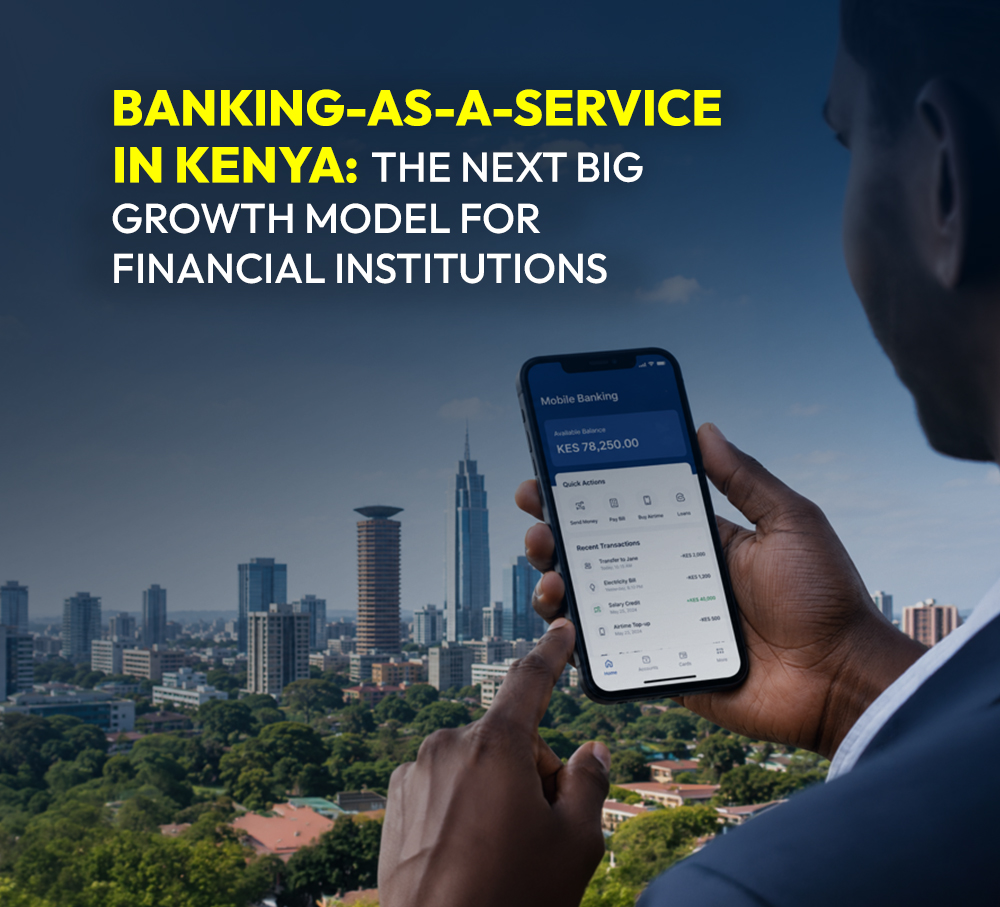
Kenya’s banking sector is at a turning point. Since almost everyone uses mobile phones and digital tools, traditional banks are forced to change. Banking-as-a-Service in Kenya offers a straightforward solution: regulated banks share their technology via APIs, enabling fintechs and other businesses to embed financial services into their own platforms.
Instead of owning every customer interaction, banks now provide core tools that others can use. While financial inclusion hit 84.8% in 2024 due to services like M-Pesa, only 18% of adults are considered financially healthy. Kenyan banks can use BaaS to grow and earn revenue without building more branches. This supports open banking in Kenya and improves digital banking through partnership rather than competition.
What Is Banking-as-a-Service?
Banking-as-a-Service, or BaaS, allows regulated banks to expose their core capabilities via secure APIs. Third parties then integrate these services into their own platforms. This moves banking from physical locations to digital delivery.
From bricks to APIs
Traditional banking relied on branches and in-person processes. BaaS replaces that with modular, API-driven access. Partners can offer financial features without obtaining full banking licenses. This reduces time to market and lowers costs for everyone involved.
What services can be embedded?
Several key services suit this model in the Kenyan context:
- Payments and transfers: Real-time processing for domestic and cross-border needs, building on existing mobile money strengths.
- Account opening and KYC: Streamlined digital onboarding with compliance checks handled by the licensed bank.
- Lending and credit scoring: Access to risk assessment tools and funding, helping fintechs serve underserved borrowers.
- Cards (virtual and physical): Issuance and management for seamless spending.
- Insurance and savings products: Embedded options that fit into everyday platforms like e-commerce or agriculture apps.
BaaS lets banks earn money from their current technology while partners focus on the customer experience. This allows banks to reach more people without greatly increasing their costs.
Why Is Kenya Ready for BaaS?
A market primed for disruption
Kenya is ready for BaaS because of its strong mobile money foundation, widespread smartphone use, and a young population seeking easy services. This is especially true since traditional banks don’t fully serve rural areas.
Ecosystem enablers already in place
Kenya has a solid support system for BaaS, including strong mobile networks, a growing fintech sector, and supportive regulators. The Central Bank of Kenya is actively updating payment and data-sharing rules. Since banks already work with non-banks and the startup scene is vibrant, deeper BaaS integration is now practical.
The Growth Opportunity for Financial Institutions
New revenue streams beyond the branch
Banks earn stable revenue from fees for APIs, transactions, and compliance services. They maintain control over deposits and loans, but partners handle distribution. This creates income that can easily grow and is less reliant on interest rate changes.
Competitive positioning in a crowded market
BaaS helps banks compete in a crowded market by enabling them to become infrastructure providers. They gain new customers through partners such as retailers or e-commerce sites without having to spend on direct marketing.
Real-world BaaS growth signals
Global BaaS markets expand quickly, and African examples show similar potential. Kenyan banks experiment with API platforms and embedded finance. Success stories from payments and lending partnerships indicate larger opportunities ahead. Banks that adopt BaaS early will gain market share as digital banking in Kenya grows.
Key Challenges and How to Navigate Them
Regulatory clarity is still evolving
The Central Bank of Kenya is still finalizing data sharing and open finance rules. Banks need to monitor updates, engage in consultations, and build flexible systems to avoid future rework.
Technology and legacy infrastructure gaps
Many core systems are older and not API-ready. Modernization requires investment in cloud solutions and secure interfaces. A phased approach, starting with high-value services, limits disruption. Partnerships with technology providers can speed up this transition.
Trust and customer education
Consumers need to trust that their data is secure and that the service quality is high. Banks must carefully monitor their partners, clearly explain the benefits, and work with fintechs on education campaigns to boost understanding and adoption. Strong adherence to regulatory policies are essential to manage risks while still allowing for innovation.
To succeed, focus on practical planning and teamwork. Small, steady improvements work better than trying to change everything at once.
How Financial Institutions Can Get Started
Start with a BaaS readiness audit
First, check your current systems, compliance, and how you manage partners. Figure out what you are already good at, like payments or lending, that can be quickly embedded. This audit will show you where the gaps are and what to prioritize.
Choose the right partner model
You need to pick the best partnership type, such as white-label services, an API marketplace, or a specific collaboration. Then review fintechs based on their reach, how well they fit your technology, and the level of risk. Use clear contracts to protect everyone involved.
Pilot, learn, and scale
Begin with limited services in one segment, such as payments for small businesses. Measure usage, revenue, and feedback before expanding. Iterative improvements build confidence and refine operations. This measured path supports sustainable growth in Open Banking in Kenya.
Institutions that follow these steps can secure a long-term advantage.
How WFIS Kenya Supports Your BaaS Journey
The World Financial Innovation Series (WFIS) in Kenya brings together banks, fintechs, regulators, and technology leaders to discuss practical BaaS implementation. The event focuses on real strategies for API integration, risk management, and ecosystem partnerships. Attendees gain insights from case studies and networking opportunities tailored to the Kenyan market.
Participation helps institutions understand regulatory directions and technology options. Sessions cover revenue models, governance best practices, and scaling challenges. By connecting decision-makers, WFIS Kenya accelerates knowledge sharing and collaboration needed for successful BaaS adoption in Kenya. It serves as a key platform for exploring how traditional players can thrive in a digital-first environment.
Frequently Asked Questions
What is the main benefit of banking as a service in Kenya?
BaaS primarily generates new fee-based revenue and expands market presence through strategic partnerships without requiring heavy infrastructure investment.
What distinguishes Kenya’s Open Banking from BaaS?
Open Banking focuses on data sharing, whereas Banking-as-a-Service (BaaS) provides full integration and direct access to banking infrastructure.
Does Kenya regulate BaaS operations?
The Central Bank of Kenya provides oversight for the sector, maintaining a framework that includes developing partnership protocols.
Which BaaS services are most effective in the Kenyan market?
By aligning with current mobile ecosystems, account services, lending, and payments offer seamless integration.
What is the recommended approach for smaller banks to enter the BaaS market?
Small banks should start with pilot programs and targeted partnerships to test business models and operations before committing fully.