


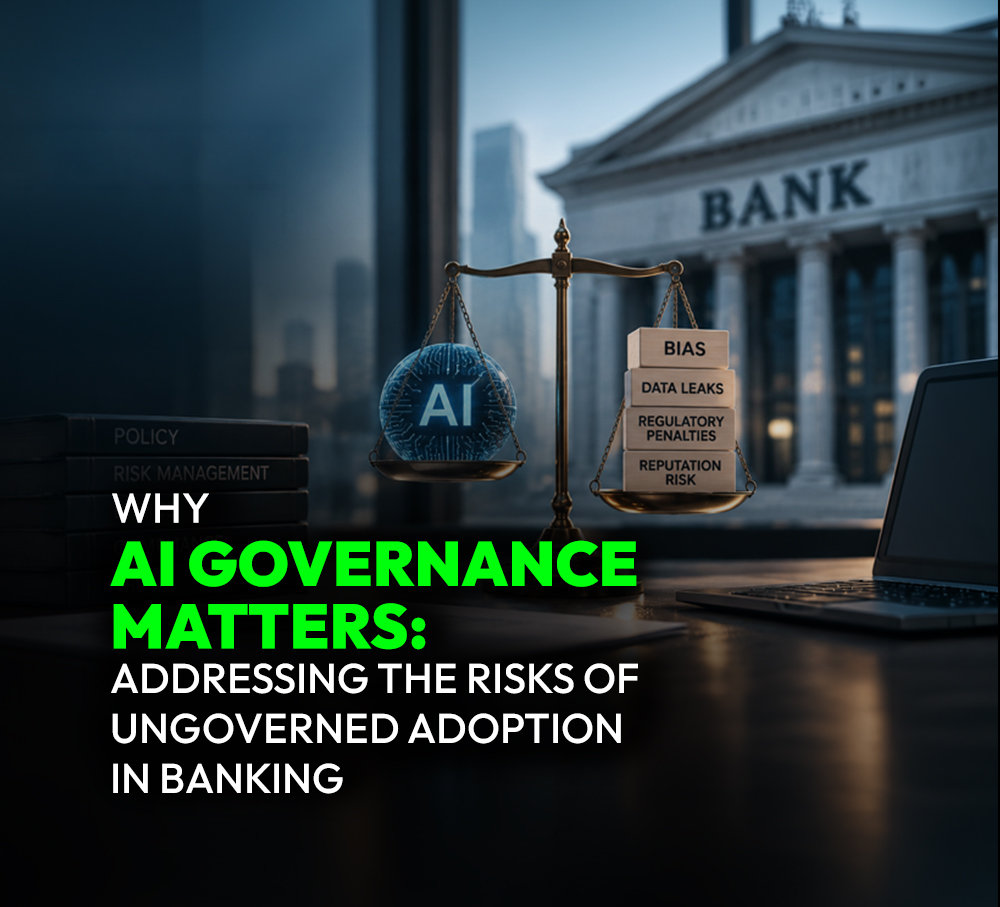
For bank boards and executive committees, AI governance is now a capital allocation and risk decision. According to the Central Bank of Kenya, half of the nation’s financial institutions have already integrated AI into their operations — yet 67% of those adopters remain AI-immature. That gap defines Kenya’s current exposure. A model that mispriced risk or misjudged a customer does not stay a technical issue. It becomes a board-level liability, a regulatory finding, or a headline, which is exactly why AI in banking in Kenya now sits on board agendas.
Understanding AI Governance in Banking
AI governance is how leadership retains accountability for decisions a machine makes at scale. It answers three questions a board should be able to answer on demand:
- Who approves this model
- How its performance is monitored
- Who is accountable when something goes wrong
A policy sitting in a compliance folder satisfies none of the three. Real governance requires ongoing reporting into risk committees, tested escalation paths, and named accountability at the executive level, not just at the model-development team. Boards that treat this as a one-time sign-off inherit risk they cannot see until it surfaces as a loss, a fine, or a customer complaint that reaches the press.
Where banks are already using AI today
- Credit scoring and alternative-data lending decisions
- Fraud detection and real-time transaction monitoring
- Chatbots supporting mobile banking service channels
- Anti-money laundering screening
- Personalised product and pricing decisions
Absa Bank Kenya, Equity Bank, and KCB have already deployed AI-driven customer service tools, and several institutions now rely on machine learning for real-time transaction monitoring. A meaningful share of fintech institutions in Kenya license these models from vendors rather than building them internally, which shifts part of the governance question to contract terms and third-party oversight rather than internal engineering alone.
Key Risks of Ungoverned AI Adoption
- Algorithmic bias becomes a fair-lending exposure. Systematic bias in credit decisions is a legal and reputational liability that surfaces in regulatory reviews and class-action complaints.
- Data exposure becomes a balance-sheet event. A breach involving personal or financial data carries direct penalties under Kenya’s Data Protection Act, 2019, alongside remediation costs that rarely stay contained to IT.
- Non-compliance becomes a licensing conversation. Regulators increasingly expect institutions to explain automated decisions on request, and an inability to do so invites closer supervision across the entire institution, not just the model in question.
- Operational failure becomes a customer-facing incident. A flawed fraud filter blocking legitimate mobile banking transactions at scale generates call-centre volume, media attention, and executive time within hours.
- Reputational damage compounds quietly, then all at once. Customers rarely complain about one unexplained rejection. They complain, publicly, once a pattern becomes visible.
Regulatory and Compliance Landscape for Kenyan Banks
Kenyan regulators have moved past observation. The Central Bank of Kenya published its Survey on Artificial Intelligence in the Banking Sector in July 2025, mapping adoption and risk across banks, microfinance institutions, and digital credit providers. Matu Mugo, the CBK’s Director of Bank Supervision, has confirmed that the regulator is finalising formal AI guidelines covering data bias, cybersecurity, and consumer protection, signalling that supervisory expectations will tighten rather than remain voluntary.
Kenya’s National AI Strategy, running 2025 to 2030, embeds financial services within a framework tied to existing data protection law, so compliance obligations will not sit in a separate AI-specific track. The Office of the Data Protection Commissioner is already examining automated credit decisions directly, given the volume of complaints tied to digital lending. For boards, the strategic choice is straightforward: build governance now on your own timeline, across fintech institutions in Kenya, or build it later under a supervisory deadline with less room to negotiate scope or pace.
Building a Strong AI Governance Framework
An executive-grade framework treats AI oversight as a standing agenda item. It starts with a cross-functional committee reporting into the board or risk committee—spanning risk, compliance, technology, and business leadership—so no material model reaches production without sign-off across all four.
Every model requires documented validation before deployment and scheduled revalidation on a fixed cycle, with credit and fraud systems held to the tightest schedule. Explainability should sit alongside accuracy as a deployment requirement, since regulators and customers both expect a reason, not just an outcome. Audit trails need to capture inputs, outputs, and human overrides in a form that would satisfy a regulator or a court, because that record is the institution’s defence when a decision is challenged. Data governance runs in parallel, aligned with the Data Protection Act, and none of it holds without executive-level ownership that survives staff turnover and vendor changes.
How WFIS Kenya Supports Responsible AI Adoption in Banking!
The World Financial Innovation Series (WFIS) in Kenya, scheduled on 2nd March 2027 at the Edge Convention Centre, Nairobi, convenes regulators, chief executives, and technology leaders to work through exactly these governance decisions before they become supervisory findings.
Panel sessions, keynote presentations, and fireside chats will follow a structured agenda designed around crucial priorities of Kenya’s rapidly evolving financial ecosystem, giving executive teams the necessary space to work through key challenges, including AI and governance. For institutions weighing how fast to move, hearing directly from others navigating AI in banking shortens the path to a defensible position with regulators and shareholders alike. Don’t miss out! Registrations are open.
Frequently Asked Questions
What is AI governance in banking?
AI governance in banking means the policies and oversight structures that ensure AI systems operate fairly, safely, transparently, and lawfully.
Why is ungoverned AI risky for Kenyan banks?
Ungoverned AI can produce biased lending decisions, expose customer data, trigger regulatory penalties, and quickly damage a bank’s reputation.
Is the Central Bank of Kenya regulating AI in banking?
Yes, the Central Bank of Kenya (CBK) is finalising formal AI guidelines after its 2025 survey found rising adoption and governance gaps across banks.
Does Kenya’s Data Protection Act apply to AI systems in banks?
Yes, any AI system processing personal or financial customer data in Kenya must comply with the Data Protection Act, 2019.
How can Kenyan banks start building AI governance?
Banks can start by forming an oversight committee, validating models before deployment, and documenting explainability, audits, and strong data controls.