


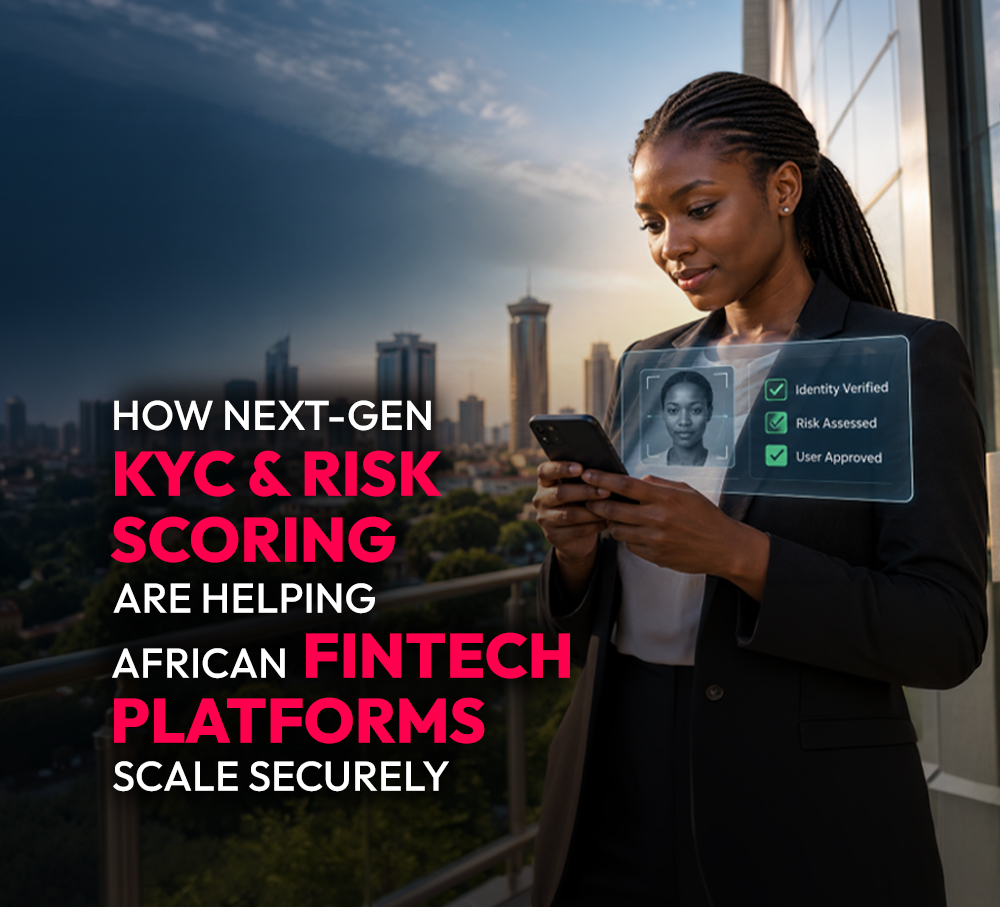
Next-gen KYC verifies a customer’s identity in real time using biometrics and government data, while risk scoring assesses creditworthiness through behavioural signals rather than paperwork. Together, these two systems are reshaping how African financial platforms grow. Kenya’s mobile money boom, led by M-Pesa, pulled millions of first-time users into formal financial services within a decade. Still, it also created a problem: verifying identities and judging risk for customers who never held a bank account.
Today, fintech platforms in Kenya are solving this by pairing automated identity checks with adaptive risk models. The result is faster onboarding, lower fraud, and a growing ecosystem built to scale without compromising security.
The Growing Need for Smarter KYC in African Fintech
Rising Fraud and Identity Risks
Fraud attempts against Kenyan digital lenders have climbed sharply in recent years. SIM swap scams, synthetic identities, and deepfake spoofing now target platforms that once relied on basic document checks, and manual verification cannot keep pace with these fast-evolving tactics.
Financial Inclusion Meets Compliance Pressure
Regulators want more people included in formal banking in Kenya, yet compliance expectations are also rising steadily. The Central Bank of Kenya has licensed 227 Digital Credit Providers as of April 2026, each required to run strict identity checks before disbursing a loan.
Regional Gaps in Identity Infrastructure
National identity systems across the region are still maturing. Kenya’s Maisha Namba rollout is improving the data foundation for verification, though coverage and connectivity gaps remain outside major urban centres.
How Next-Gen KYC Technology Works
Biometric and Document Verification
Modern KYC solutions rely on a three-pronged approach to authenticate identity:
- Document analysis to read and verify official ID formats
- Facial recognition to cross-reference the user with their photo ID
- Liveness checks to prevent spoofing via still images or altered video
Real-Time Identity Verification
Instead of manual review that once took days, identity checks now run against government databases and watchlists within seconds. Optical character recognition extracts details from an ID card, and flags mismatches automatically before an account is opened for use.
Streamlined Digital Onboarding
Onboarding built for smart banking now works across WhatsApp, SMS, USSD, and mobile apps, meeting customers wherever they already are. Low-bandwidth optimization matters here, since many users complete onboarding on modest devices and inconsistent networks rather than fast connections.
Risk Scoring Models Built for African Markets
Alternative Data for Credit Assessment
Conventional credit bureaus rely on formal financial track records that most Kenyans lack. Alternative data addresses this shortfall through:
- Mobile wallet transaction volume and regularity
- Airtime recharge behavior
- Utility and bill payment records
Evaluating Unbanked and Underbanked Populations
By analysing mobile wallet transaction behaviour and repayment patterns, lenders can responsibly extend credit to millions of adults across the region who have a mobile phone but lack a traditional bank account. This approach directly fosters broader fintech expansion in Kenya.
Machine Learning-Driven Risk Models
Machine learning models trained on these behavioural signals refine their predictions as new repayment data arrives from active borrowers. This adaptive approach improves accuracy over static scorecards and helps lenders price risk fairly rather than rejecting entire segments outright.
Benefits of Combining KYC and Risk Scoring for Secure Scaling
Combining identity verification with risk scoring produces three measurable outcomes for fintech firms operating in Kenya:
- Lower fraud and default rates, since fraudulent applications are caught earlier and genuine borrowers are approved with confidence
- Faster compliant onboarding for platforms serving banking customers in Kenya, since checks that once took days now complete in minutes without expanding manual review teams
- Stronger investor and regulator confidence, since auditable compliance records make licensing, supervision, and fundraising more straightforward
Together, these outcomes let fintech firms grow their customer base steadily without letting fraud losses or compliance gaps grow alongside them at the same pace.
Challenges and Considerations for Implementation
Data Privacy and Consumer Trust
Gathering biometric and behavioural information naturally creates privacy concerns for security-conscious consumers. Under Kenya’s Data Protection Act, organisations face strict guidelines regarding data retention and user consent; therefore, financial technology firms must remain fully transparent about their data usage practices and deletion schedules.
Infrastructure and Connectivity Gaps
Not every customer has a fast, stable internet connection. Verification systems must function reliably on low bandwidth and older devices, or large segments of the intended market will be excluded from the outset.
Balancing Security with User Experience
High onboarding friction deters legitimate users, whereas overly lenient verification increases vulnerability to fraud. Successful financial technology systems apply targeted authentication protocols selectively based on actual risk indicators, avoiding one-size-fits-all requirements across applicants.
Explore the Next Chapter of Secure Fintech Growth with WFIS Kenya!
To achieve secure, scalable fintech growth in Kenya, financial institutions need foundational infrastructure capable of precise identity verification and intelligent risk assessment from the initial interaction.
The World Financial Innovation Series (WFIS) in Kenya serves as a collaborative platform that unites financial executives, regulatory leaders, and identity technology providers to examine critical operational areas, including user onboarding framework design, fraud mitigation tactics, and cross-border regulatory compliance.
Financial institutions seeking to implement robust smart banking solutions can use these discussions to evaluate proven, field-tested methodologies rather than unverified theoretical models. Ultimately, the future landscape of secure fintech expansion in the region will be defined by forward-looking organizations that prioritize these operational foundations, and WFIS Kenya—scheduled on 2 March 2027 at the Edge Convention Centre, Nairobi—serves as a critical forum where these priorities are shaped into action.
Frequently Asked Questions
What is next-gen KYC?
Next-gen KYC uses biometric matching, liveness detection, and real-time database checks to confirm a customer’s identity within seconds, with high accuracy.
Why does risk scoring matter for African fintech firms?
Risk scoring lets lenders assess unbanked customers using mobile money and transaction data instead of requiring formal credit bureau records.
Is digital KYC secure in Kenya?
Yes, when combined with liveness detection and CBK-aligned compliance controls, digital KYC currently meets Kenyan regulatory security expectations fairly closely.
Can alternative data replace credit bureaus?
Not entirely, but alternative data meaningfully supplements bureau records, particularly for customers who lack any formal documented credit history.
How does KYC support financial inclusion?
KYC lets fintech institutions safely verify and onboard many previously excluded customers, extending credit and banking services responsibly to underserved communities.