


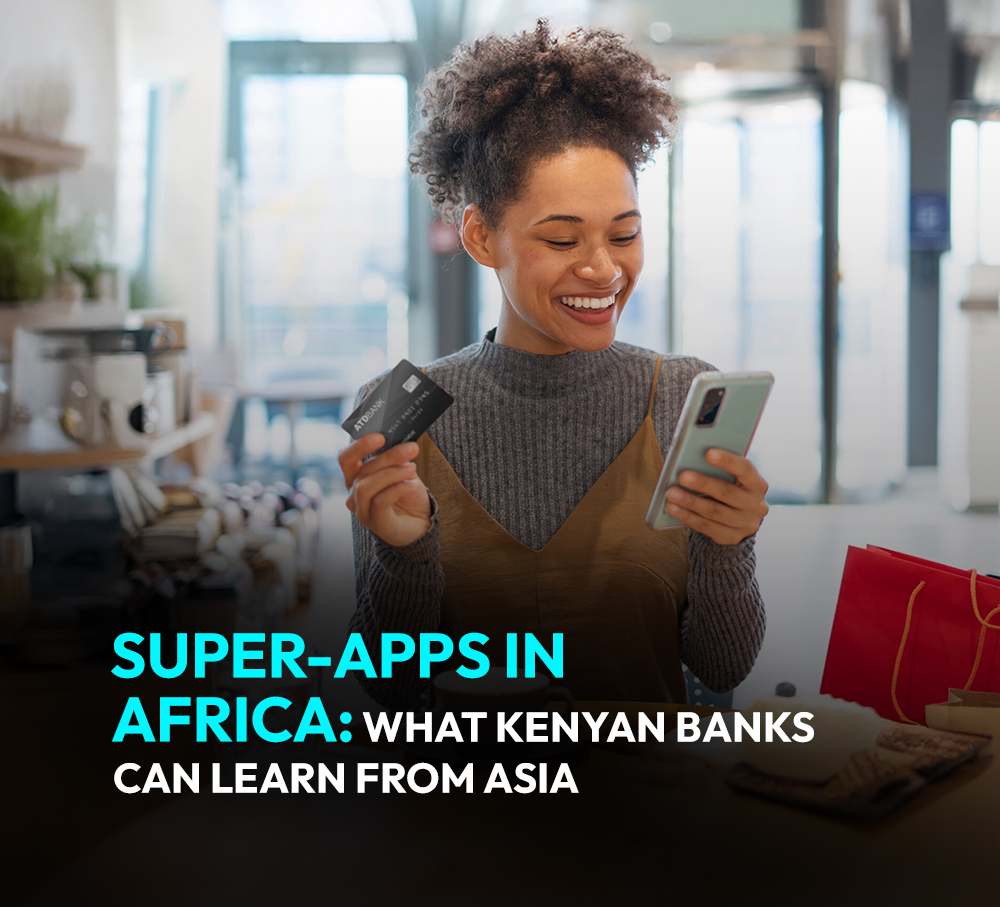
Customer expectations in global financial markets are now defined by platform economics, not traditional banking models. The ‘consumerization’ of finance – driven by ride-hailing, e-commerce, and digital payments – has fundamentally changed the standard. Users expect a single, seamless digital experience that connects multiple services in real time.
This shift has made super-apps one of the most influential business models in modern financial services. While perfected in Asia, the concept is now being actively debated in Fintech Kenya circles – a rapidly evolving market category – where mobile-first consumers and strong digital adoption create fertile ground for platform-led banking.
As digital transformation in Kenya accelerates across payments, lending, and insurance; Kenyan banks are evaluating how ‘super-app thinking’ could reshape digital banking Kenya – the country’s rapidly expanding e-banking domain – beyond traditional channels. The question is no longer if the platforms will dominate, but how regulated banks can participate strategically in such an ecosystemic shift.
What Is a Super-App? Lessons from Asia
A super-app is not merely a mobile app with several features – it’s a platform that embeds financial services into everyday digital behavior.
Asian super-apps like WeChat, Alipay, and Grab succeeded by integrating payments, commerce, transport, credit, insurance, and lifestyle services into a single, intuitive interface. The key lesson here is orchestration, because these platforms positioned financial services as enablers rather than standalone products.
Instead of forcing users to “go to the bank,” super-apps meet customers where they already spend time – chatting, shopping, commuting, or managing daily tasks. This approach drives high-frequency engagement, allowing platforms to collect contextual data and personalize services at scale.
Another critical insight is the ecosystem thinking. Asian models thrived by partnering aggressively with merchants, service providers, and developers – turning super-apps into digital marketplaces.
For banks exploring platform strategies, the Asian model highlights the importance of API-driven architecture, data intelligence, and customer-centric design, elements that are increasingly relevant for digital banking in Kenya – especially today.
Africa’s Super-App Experiments, & Kenya’s Position
Africa’s journey towards super-apps has followed a unique path, rooted in mobile money instead of messaging or e-commerce activities. Platforms like M-Pesa, Flutterwave, and Wave have demonstrated that payments can scale rapidly when they solve contextual, real-world problems. In the emerging economic category of ‘Fintech Kenya,’ M-Pesa’s evolution into savings, credit, and merchant services already resembles the prototype for a super-app model.
Kenya’s advantage lies in its digitally mature consumer base, strong agent networks, and regulatory experience with large-scale financial inclusion. However, unlike Asia, African platforms often evolved around a single dominant use case rather than a broad lifestyle ecosystem.
This creates both opportunity and limitation. Banks entering this space must recognize that customers already trust mobile money platforms, while also expecting banks to deliver deeper financial products.
As digital transformation in Kenya continues to blur lines between telecoms, fintechs, and banks, Kenya stands at a strategic inflection point – to expand vertically within banking, or integrate horizontally into broader digital ecosystems.
What Asian Super-Apps Did Right
Asian super-apps succeeded because they optimized for behaviour, not products.
First, they focused relentlessly on daily utility – payments, messaging, food delivery, transport – ensuring users opened the app multiple times a day. This frequency created data-rich environments that powered credit scoring, cross-selling, and personalization.
Second, they adopted a modular architecture. Financial services such as lending, insurance, and wealth were layered gradually on top of a stable core, allowing rapid experimentation without disrupting the user experience.
Third, partnerships were centralized. Super-apps did not try to build everything themselves; they enabled third parties through APIs, revenue-sharing models, and embedded finance.
Finally, trust was embedded through consistent UX enhancements, strong fraud controls, and rapid dispute resolution. For Kenyan banks, these lessons emphasize that super-app success is not about launching many features at once, but about creating value.
As digital banking in Kenya evolves, banks must think beyond channels and, instead, towards continuous engagement loops driven by real customer needs.
What’s Different in Africa
Africa’s super-app journey faces unique structural challenges. Regulatory boundaries between banking, telecom, and fintech are more pronounced, requiring careful compliance design. Infrastructure disparities, such as device affordability and network reliability, also shape user behaviour differently than in Asia.
However, these constraints create powerful opportunities. Kenya’s high mobile money penetration, strong KYC frameworks, and open banking momentum provide a strong foundation for platform-based innovation. Unlike Asia’s consumer-led models, African super-apps can be inclusion-led, solving access gaps in credit, insurance, and micro-investments.
For Fintech Kenya, the opportunity lies in designing super-app strategies that balance regulation with agility. Banks that collaborate with fintechs, merchants, and government platforms can build trust-driven ecosystems tailored to local economic realities, rather than copying Asian models outright.
A Practical Super-App Strategy for Kenyan Banks
A. Clarify Your Role in the Ecosystem
Kenyan banks must first decide whether they aim to be ecosystem orchestrators or embedded service providers, because not every bank needs to own the front-end experience. Some may win by empowering platforms through APIs and balance-sheet capabilities.
B. Design the Core Value Proposition
Every successful super-app starts by fulfilling something people need every day. That could be payments, helping small businesses manage cash flow, or offering quick credit for everyday purchases.
This core should drive people to keep coming back, before additional services are layered on top.
C. Build the Experience & Platform Foundations
Banks need flexible, modular systems that can connect with other platforms. The ones that still run on rigid, outdated infrastructure will struggle to bring on partners quickly, or launch new features without months of delays.
Therefore, banks pursuing digital transformation in Kenya, must move away from monolithic systems to enable speed and scalability at the ecosystem level.
D. Data, Risk & Governance Layer
Super-apps thrive on data, but trust is non-negotiable.
Banks must therefore monitor risk as it happens in real-time, explain how their algorithms make lending decisions, and give customers real control over how their data is used.
E. Test, Iterate, and Scale
Rather than launching nationwide, banks should pilot targeted segments – SMEs, youth accounts, urban merchants – and scale only after proving the feasibility of the model. Such an agile approach is how successful fintechs in Kenya have actually grown.
Risk, Cybersecurity & Trust in the Super-App Era
Super-apps create new kinds of risk. When everything runs through one platform – payments, identity, financial records – a single hack can expose it all at once.
For Kenyan banks, this means cybersecurity can’t just be about ticking regulatory boxes. It has to be built into the foundation – i.e., assume nothing is safe by default, verify users constantly, and use smart systems to catch fraud before it spreads.
Just as critical as it is to build strong security, it is equally important to be upfront with customers who need to understand how their data is being used, and what’s being done to protect it.
In Kenya, trust drives adoption – if customers don’t feel safe, they won’t use the platform. Banks that build strong security early will be able to grow without constantly worrying that one incident could erode their reputation and plummet customer confidence.
Stay Ahead in the Super-App Wave With WFIS
At the World Financial Innovation Series – a leading banking and fintech summit held worldwide – see how embedded finance, ecosystem-led innovations, and super-app models are changing customer engagement and competitive strategy.
At the landmark seventh edition in Kenya ,on 3 March 2026, network and connect with the region’s most influential banks, regulators, fintechs, and platform leaders navigating the shift from products to ecosystems – and learn what’s actually working on the ground.
Whether you’re building your first ecosystem model or refining an existing platform strategy, WFIS Kenya gives you direct access to the insights, connections, and tactical know-hows shaping Africa’s financial landscape.
There will be a pre-qualified gathering of over 500 of the most influential financial decision-makers in the region, along with a curated agenda exploring embedded finance, ecosystem-led innovations, super-app models, competitive CX strategies, and more through expert-led panel discussions – with much more.
Reserve your seat today and gain the competitive intelligence needed to win in Kenya’s rapidly digitizing financial economy!
Event Details
Date: 3 March, 2026
Venue: Edge Convention Centre, Nairobi
Don’t miss out – secure your spot today!